The Math on Doing It Yourself
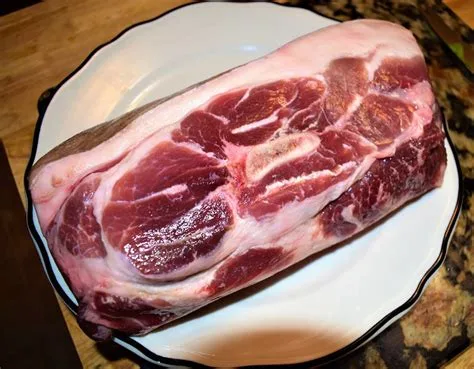
The end product. Meishan shoulder, marbled through.
This June we processed two Meishan hogs on the farm.
Not at a facility. On the farm, with a tractor hoist, sawzall, sharp knives, positive attitude, and a 2 weekends. Two animals, two sessions, roughly 200 pounds of packaged pork in the family freezer by the time we were done.
The question worth answering honestly: what did that actually cost, and does it work?
What it costs to raise a feeder pig
Both hogs started as feeder pigs we purchased for $200 each. Over the raising period, each ran approximately $400 in feed, based on the herd’s total feed cost spread across animal-months. Each animal went into processing at a cost basis of roughly $600 cash.
The first hog weighed 362 pounds live, hung at 182, and packaged to 109 pounds including 33 pounds of bulk sausage. Cost to produce: $5.50 per pound.
The second, 338 pounds live, is tracking better. Higher dressing percentage, estimated 128 to 137 pounds packaged when we finish weighing the hams and bacon. Preliminary cost per pound around $4.55 if the final weights come in at the midpoint.
Why processing location is the variable that matters
Processing costs come in three tiers depending on what you need the product for.
A USDA-inspected cut-and-wrap facility charges around $600 per animal. That fee is the legal requirement for retail pork sales. Inspection is what makes the product sellable. On a $600 investment animal, adding $600 in processing gets you to $1,200 total. At 109 pounds packaged, that is $11 per pound. The economics do not work at that number against any market comparison.
A custom butcher shop charges around $200 per animal. No USDA inspection, which means the meat is for personal and farm use only, not for resale. Same $600 investment, $800 total: roughly $7.34 per pound. That lands just below the pasture-raised whole-hog market price of $7.96 per pound, and well below the by-the-cut market at $10 or more. The margin on the whole-hog comparison is narrow. Against by-the-cut prices it is a clear positive.
On-farm processing: $0 cash. Same $600 investment, 109 pounds packaged, $5.50 per pound. That is where the math works.
What the product is worth against the market
Commodity grocery pork runs about $4.33 a pound for boneless chops nationally this spring. Heritage pork raised on pasture and forest cannot compete at that price, and it was not designed to.
The right comparison is pasture-raised pork, because that is what this product is. USDA Q1-2026 data puts pasture-raised ground pork at $9.80 per pound and chops at $12.75. The whole-hog direct market runs $7.96 per pound.
At those prices, here is what 109 pounds of packaged pork returns at each processing tier:
| Processing | Total cost | Cost/lb | vs. whole-hog ($7.96) | vs. by-the-cut ($10+) |
|---|---|---|---|---|
| On-farm ($0) | $600 | $5.50 | +$268 (+45%) | +$490+ (+82%+) |
| Custom butcher ($200) | $800 | $7.34 | +$68 (+8%) | +$290+ (+36%+) |
| USDA facility ($600) | $1,200 | $11.01 | −$554 (−46%) | −$109 (−9%) |
On-farm processing is the economic foundation. The custom butcher route is viable for anyone not set up to process on-site. The margin is thin against the whole-hog market but real, and it improves as you move toward by-the-cut pricing.
The provenance benefit
The math is one side; provenance is the other.
Processing your own animals removes the guesswork. You know exactly how the animal was treated and you are in control of the processing. In a market where labels like “pasture-raised” can be vague, absolute transparency on how an animal lived and was processed is a tangible asset. For us, that transparency is a non-negotiable value.
What the law allows right now
HB394 has passed, establishing a state meat inspection program in Tennessee. This legislation creates a pathway for small facilities to get state inspection, provided they meet standards at least equal to USDA requirements.
Under current rules, however, custom-exempt on-farm processing produces meat that cannot be sold. Everything processed this June stays in our family freezer. The law does not have a gray area here.
We are building our facility to near-USDA standards now, which means we are strategically aligned for the state inspection rollout as it happens. For now, the value is in what goes on four households’ tables. Given what four families eat in a year, that is not a small amount of food.
Where we are
Hog #2 is not fully closed. The hams and bacon are still being weighed. When the final numbers are in, the harvest log will update.
The working summary: two pigs, roughly $1,200 invested, an estimated 230-plus pounds of pork, cost basis in the $4.50 to $5.50 range. We cannot beat commodity grocery prices on pork. In the pasture-raised market, where this product belongs, the numbers work.
The next animal we process will go faster and cost less than this year. That is how it is supposed to go.
Run the same math on your own farm
The math proves that starting with high-quality feeder pigs is the best way to keep your costs down while raising heritage pork. The pigs in this analysis were Meishan feeders from our own herd. Raised on pasture and forest, these are animals built for this environment.
If you are thinking about buying a feeder pig and running your own numbers, use these three steps to see if the math works for your setup:
- Calculate your cost basis: Start with the purchase price of the feeder + estimated feed costs per animal.
- Choose your processing tier: Compare $0 (on-farm), ~$200 (custom butcher), or ~$600 (USDA facility).
- Compare to local market: Divide total cost by estimated packaged weight and compare that against pasture-raised prices in your area.
If you want to run these numbers yourself
It starts with the feeder pig.
We sell Meishan feeders from the same herd described above, raised the same way. $250 for pigs under twelve weeks. The litter born August 24 will be weaned and ready to go home the third week of October.
Message us on Facebook or email info@swiftspringhollow.com and we will tell you what is actually available.
Sources
- USDA Agricultural Marketing Service, Pasture Raised Pork Direct-to-Consumer Retail Report Q1 2026 (PDF)
- Tennessee General Assembly, House Bill 394 - State Meat Inspection Program (Statute Text)